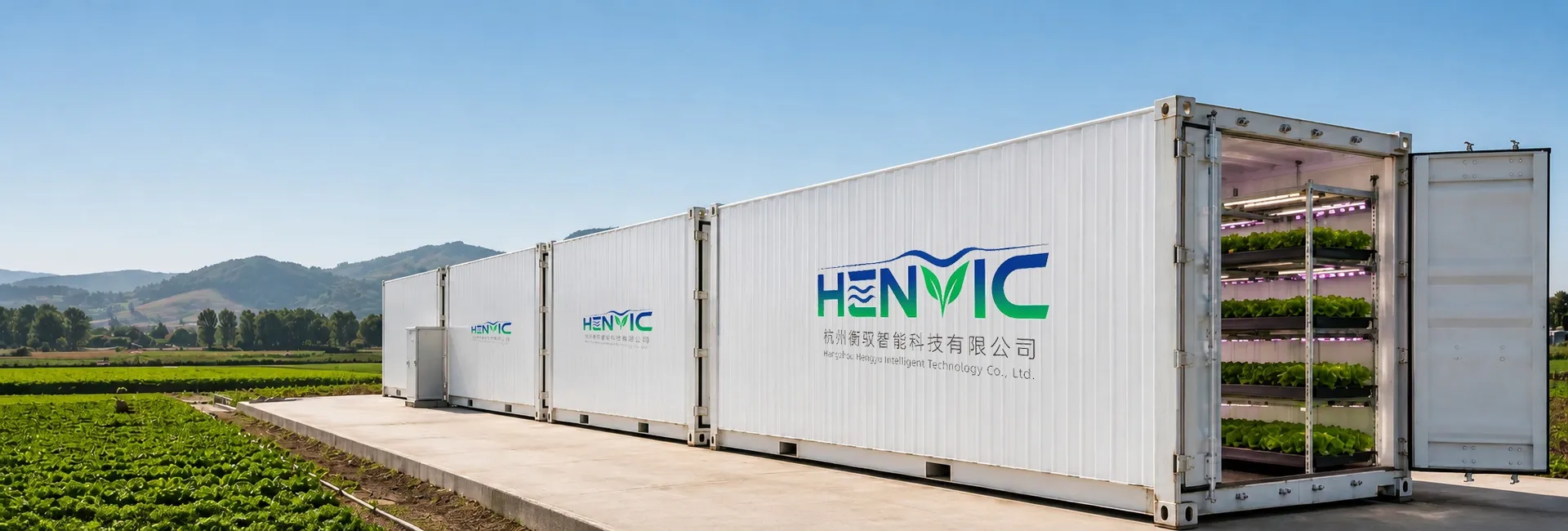
A container farm's decisive break with every previous form of agriculture is that it has no sun, and this single fact is at once its greatest freedom and its heaviest liability. In a field or a greenhouse, light arrives as a package the grower does not choose: a spectrum determined by solar physics, an intensity that rises and falls with cloud and season, a photoperiod fixed by latitude and calendar. Inside a sealed box, all three become variables. Weather becomes engineering. But the disappearance of the sun also eliminates the one input agriculture has never had to purchase. Every photon that reaches a leaf in a container farm is paid for, and lighting accordingly dominates the operating cost of most vertical farming systems, typically accounting for forty to sixty percent of electrical consumption, with the cooling load that lighting itself generates adding substantially more on top. Spectral formulation is therefore not a botanical refinement applied on top of an energy problem. It is the point at which crop physiology and the electricity meter are directly coupled.
Photons, not watts: the units that make the trade-off legible
The most common analytical error in this field is to reason in watts. A crop does not respond to energy; it responds to photons within a defined waveband. Photosynthetically active radiation spans roughly 400 to 700 nanometres, and the biologically meaningful quantity is the number of photons in that band arriving per unit area per unit time — the photosynthetic photon flux density (PPFD), expressed in micromoles per square metre per second. Integrated over a photoperiod, this yields the daily light integral (DLI) in moles per square metre per day, the quantity most closely correlated with accumulated yield. A luminaire's performance is properly stated as photosynthetic photon efficacy — micromoles of PAR photons delivered per joule of electrical energy consumed — not as nominal wattage.
The distinction has teeth. Two fixtures drawing identical power can deliver very different photon counts, because photon energy is inversely proportional to wavelength. A red photon near 660 nm carries roughly 1.8 times the energy of a blue photon near 450 nm, so for the same radiant energy, red light yields more photons. Because photosynthesis at these wavelengths proceeds on a photon-count basis, red photons are effectively cheaper — and this single physical fact underlies every spectral decision that follows.
The McCree curve, and why wavelength is not a binary choice
The crop's spectral responsiveness is described by the McCree action spectrum, which plots photosynthetic quantum yield — carbon fixed per photon absorbed — against wavelength. The curve shows a broad maximum in the red region around 610–680 nm, a secondary peak in the blue near 430–460 nm, and a pronounced minimum in the green around 500–550 nm, where quantum yield falls to roughly half its red-region value. Read at face value, this appears to vindicate the practice common in early vertical farms: illuminate with red and blue alone, concentrate all input in the two efficient peaks, and discard the spectrally wasteful remainder.
That conclusion is mistaken, and the reasons bear on both productivity and quality.
The narrow-band trap
The Emerson enhancement effect. When far-red light near 700–730 nm is supplied together with shorter-wavelength red near 650–680 nm, the photosynthetic rate exceeds the sum of the rates achieved by each alone. The mechanism resides in the two photosystems: red at 680 nm preferentially excites photosystem II, while far-red above 700 nm preferentially excites photosystem I, and balanced excitation of both yields a higher quantum efficiency than driving either in isolation. A spectrum lacking far-red therefore leaves measurable photosynthetic capacity unused — an efficiency loss that appears as lower yield per mole of photons delivered, precisely the opposite of what narrow-band formulation was intended to achieve.
Morphology. Red-dominant light produces elongated stems, thin leaves, and an expanded, sprawling canopy — the shade-avoidance response mediated by phytochrome, in which the plant reads a red-heavy spectrum as a signal of competition and invests in vertical extension rather than compact structure. Blue light drives stomatal opening, chlorophyll synthesis, and a tight, well-organized canopy. The practical consequence is that crops grown under a red-dominant spectrum tend toward loose, floppy growth that is awkward to manage within confined tiers and more prone to mechanical damage during handling.
Secondary metabolism and appearance. The compounds that determine flavour, colour, and nutritional density — anthocyanins, carotenoids, phenolic compounds, ascorbate — respond to spectral cues largely unrelated to photosynthetic efficiency. Blue and ultraviolet wavelengths are especially influential in triggering the accumulation of protective secondary metabolites. A crop optimized purely for photon efficiency can therefore produce abundant biomass that tastes flat, looks pale, and carries a measurably poorer nutritional profile. For premium markets, where the product competes on quality rather than tonne per square metre, this is an economic failure even when the yield figures look satisfactory.
Canopy penetration. Green light, though of low quantum yield at the leaf surface, is poorly absorbed by chlorophyll and consequently travels deeper into the canopy and transmits through upper leaves. In a densely planted vertical system, green photons can reach lower leaves that red and blue never penetrate, so a modest green fraction can lift whole-canopy photosynthesis above what a leaf-level efficiency calculation would predict. The canopies of container farms — tier stacked upon tier at high planting density — are precisely where this effect matters most.
Where LED efficacy actually sits on the spectrum
Against the biological case for broad-spectrum formulation stands the physics of the diodes, and the two do not align comfortably.
LED wall-plug efficiency varies markedly across the visible range. Deep-red emitters near 660 nm are the most efficient solid-state sources available, routinely exceeding sixty percent conversion efficiency in production devices, because the semiconductor material system is well matched to that emission energy. Blue emitters near 450 nm are also mature, though generally below the best red performance. Far-red emitters near 730 nm are considerably less efficient, and violet and ultraviolet emitters worse still. Green emitters have historically been the weakest of all, because the bandgap required for green emission is difficult to grow with high internal quantum efficiency — the long-standing difficulty known in the industry as the green gap.
The consequence is direct: the photons the plant most wants and the photons that are cheapest to produce are not the same photons. Far-red, which biology says to include for Emerson enhancement, is energetically expensive to generate. Green, which biology says to include for canopy penetration, is the least efficient to produce. Red, the cheapest to generate and the most photosynthetically productive, is the one whose overuse distorts morphology. Spectral formulation is therefore a negotiation among a quantum-yield curve that favours red, a morphology requirement that demands blue, an enhancement mechanism that wants far-red, and a semiconductor efficiency curve that penalizes exactly the wavelengths biology asks for.
The energy ledger beyond the luminaire
Even a spectrally optimal fixture leaves the system-level energy question open, and several factors push the true cost of delivered photons well above nameplate efficacy.
Photoperiod versus intensity. The same DLI can be delivered by high intensity over a short period or lower intensity over a longer one. Crops generally saturate photosynthesis above a certain PPFD, so photons delivered beyond the saturation point are dissipated as heat rather than fixed as carbon. Extending a moderate photoperiod therefore converts electricity to biomass more efficiently than raising intensity — up to the ceiling imposed by crop physiology and the daily dark requirement. Choosing the photoperiod is as much an energy decision as a biological one.
The heat the light creates. Not all electricity entering the luminaire becomes PAR photons; the remainder becomes heat, and the PAR photons themselves are eventually dissipated as heat after absorption. In a sealed box, all of that energy must be removed by the cooling system, so the true energy cost of lighting is the luminaire's consumption plus the refrigeration power required to remove the resulting heat. Improving efficacy reduces both terms, which is why high-efficacy LEDs repay their capital cost twice over — once in lighting energy and again in reduced cooling load.
Thermal derating and spectral stability. LED efficacy and emission wavelength both shift with junction temperature. A fixture run hard and cooled poorly produces fewer photons, at slightly longer wavelengths, than the same fixture at design conditions, and it degrades faster. Thermal management of the luminaire is thus part of the spectral specification, not merely a reliability concern.
Dimming and scheduling. Because lighting is the dominant load and crop demand varies across the production cycle, the ability to dim and schedule is among the highest-return controls available. Matching photon delivery to developmental stage — lower DLI during establishment, full DLI during rapid vegetative growth — avoids spending expensive photons on a canopy that cannot use them. Where time-of-use tariffs apply, shifting lighting into off-peak hours cuts cost without altering the DLI delivered.
Formulating a spectrum as an optimization, not a recipe
The practical implication is that spectrum should be treated as a multi-objective optimization problem rather than a fixed recipe copied from a catalogue. The objectives are at least four: maximize photosynthetic productivity per photon delivered, maintain a canopy architecture the physical space can accommodate, accumulate the secondary metabolites the target market values, and accomplish all of it at the lowest achievable electrical cost per photon.
These objectives do not all point the same direction, and the weighting among them depends on what the farm is selling. A producer supplying commodity leafy greens priced per kilogram will weight photon efficiency and yield heavily, accept a somewhat narrower spectrum, and tolerate a looser canopy provided handling remains workable. A producer supplying premium herbs or baby leaf to restaurants and specialty retail will weight morphology, colour, and flavour compounds more heavily, accept a lower efficacy figure, and recover the cost through price rather than volume. A propagator selling transplants has yet another weighting, because canopy compactness and root-to-shoot ratio matter more than absolute biomass.
Because crop response to spectrum is species-specific and frequently cultivar-specific, the optimization cannot be completed on paper. The relevant parameters — the red-to-blue ratio that produces the target morphology in a given cultivar, the far-red supplementation that yields a measurable photosynthetic gain, the total spectrum that best serves quality at acceptable efficacy — must be established empirically for each crop the farm intends to grow. The value of that experimental work lies precisely in the fact that it cannot be replaced by a general recommendation.
The photon as the unit of both biology and economics
What makes container farming a genuinely distinct discipline from greenhouse horticulture is that the same physical quantity — the mole of PAR photons — is simultaneously the input to a biochemical process and the unit printed on the electricity bill. There is no free fraction, no sunlight subsidy, no seasonal dividend. Every improvement in the system ultimately reduces to an improvement in the ratio between the light the crop uses and the light the farm pays for.
Framed this way, the tension between spectral formulation and energy consumption is not a problem to be settled once and then forgotten. It is the recurring design problem of the entire enterprise. Spectrum determines whether delivered photons become biomass, become the morphology the space can support, and become the quality attributes the market will pay for. Efficacy determines what those photons cost. A farm that optimizes only one side — chasing the cheapest photons with a nutritionally and structurally compromised spectrum, or pursuing a biologically ideal spectrum with no regard for the electrical bill — will find its advantage cancelled by the variable it neglected. The operations that work are those that treat the photon count as the common currency of both their agronomy and their accounts, and tune the spectrum until the two ledgers agree.