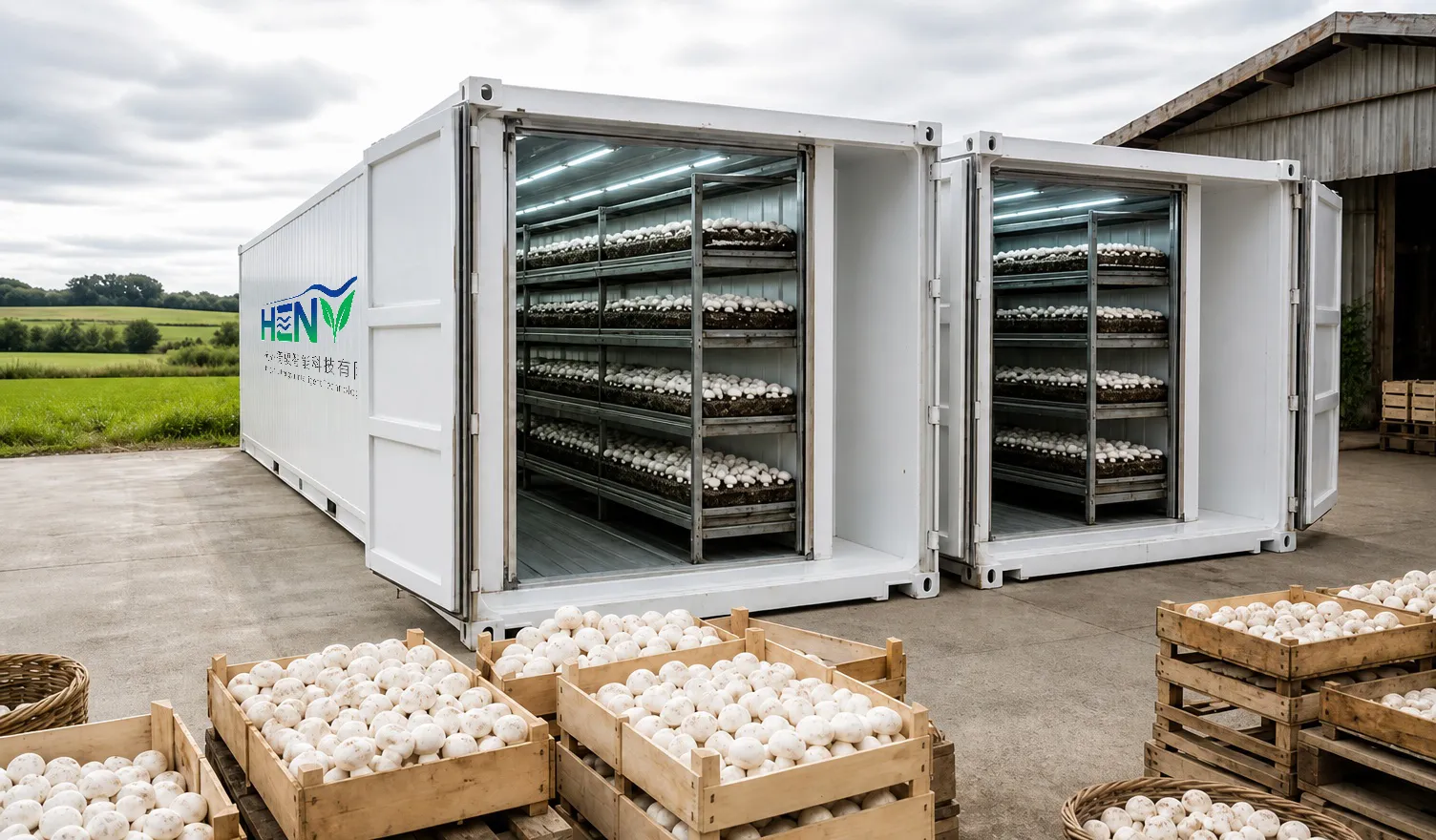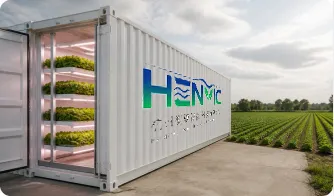
Mushrooms are not a single climate problem. A container built for oyster mushrooms and one built for shiitake differ less in their equipment list than in how that equipment is sequenced, because the crop passes through physiologically distinct stages that want opposite conditions. Designing a mushroom container means designing a staged climate machine with a strict hygiene boundary around it.
Spawn run is the first zone requirement. Mycelium colonising substrate generates metabolic heat, roughly in proportion to dry matter and biological efficiency, and it needs a warm, CO₂-rich, dark environment. Incubation rooms typically run near 22–25 °C substrate temperature with CO₂ allowed to climb into the thousands of ppm, since high CO₂ suppresses pinning and keeps growth vegetative. Substrate temperature, not air temperature, is the control variable, which means probe placement inside the block or bag rather than at the wall. A container used for spawn run needs enough cooling capacity to remove metabolic heat at peak, and that load can rival the lighting load in a leafy-green unit despite the absence of lamps.
Fruiting is a different machine. Pinning requires a temperature drop, a sharp reduction in CO₂, high humidity, and light — even a modest photoperiod at low intensity is enough to trigger and orient primordia. The transition is the critical control point: CO₂ must fall fast enough to initiate pins but not so fast that the block dries before primordia set. Evaporative demand rises as CO₂ drops, so humidification capacity has to be sized for the fruiting stage, not the average.
Humidification choice carries consequences. Ultrasonic and centrifugal foggers deliver fine droplets that evaporate in the air, adding moisture without wetting the crop, but they require demineralised water or they leave white mineral deposits on caps. Steam or high-pressure systems distribute more evenly but add a sensible heat load that the cooling system must absorb. The practical rule is to keep leaf and cap surfaces dry: free water on a mushroom cap is a bacterial blotch invitation.
Contamination control is the decisive design constraint and is largely a matter of pressure and flow. A mushroom container should be positively pressurised relative to the outside, with HEPA filtration on supply air and a staged pressure cascade from clean corridor to fruiting room to harvest vestibule. Airlocks or at minimum double-door vestibules with interlocked entry keep the pressure boundary intact during harvest. Floors should be coved, drains should be trapped and accessible, and all surfaces should tolerate a quaternary ammonium or peracetic acid washdown. Trichoderma and cobweb mould do not arrive through the filter; they arrive on shoes, crates and hands.
Water quality deserves the same scrutiny as air. Mushroom watering and humidification introduce water directly onto the crop, so a potable-grade supply with monitored microbial counts is a baseline. Recirculated condensate is acceptable for irrigation of substrate-bound crops only after treatment, and should never be used for humidification fog.
Harvest and post-harvest logistics shape the container layout more than growers expect. Mushrooms are highly perishable and generate respiratory heat after picking, so a pre-cooling step at 2–4 °C should be physically adjacent to the fruiting room, and the cold store should be outside the positive-pressure envelope. Crates and harvest tools need a dedicated wash station. A layout that forces picked product to travel back through the fruiting room defeats the sequestration the design was built for.
Finally, control logic must be stage-aware. A single setpoint schedule applied across the whole container will either keep spawn run too cold or fruit too dry. The practical approach is to partition the container into independently controlled zones, or to run a batch system where an entire container moves through stages together, and to lock recipes so operators cannot inadvertently run a fruiting recipe during incubation. Recipe discipline, documented and audited, is as important as the equipment specification.