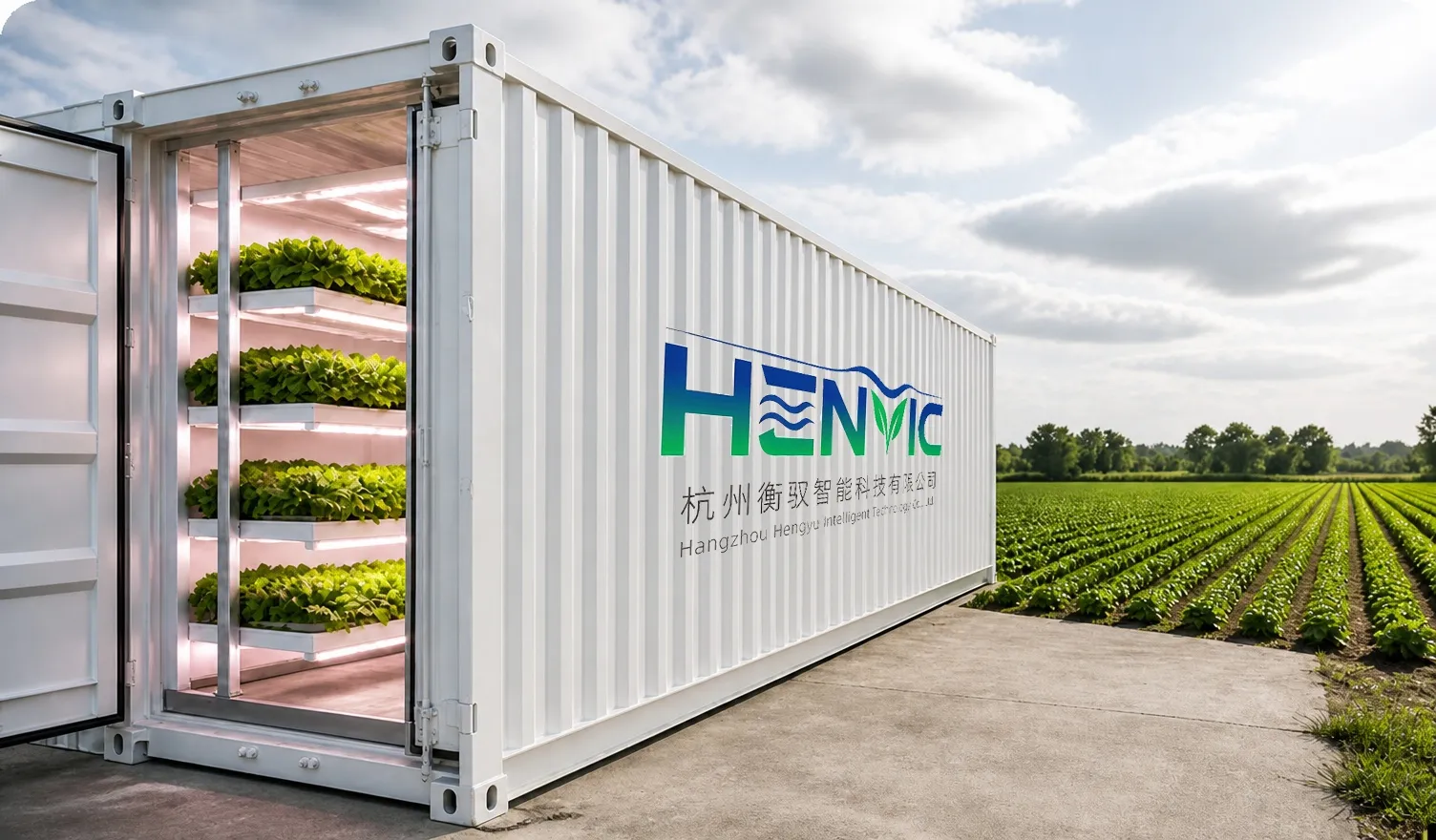
A conventional greenhouse holds conditions steady. A smart container farm does something different: it perceives, decides, and acts in a continuous loop, then revises its own decisions based on what happened last time. That difference is architectural, not incremental. Intelligence in a container farm is not a single clever controller bolted onto an HVAC unit — it is three distinct layers stacked on top of each other, each one only meaningful because the layer beneath it exists. The physical layer carries the crops. The perception layer gives the system senses. The control layer gives it judgment. Remove any one and the farm stops thinking; it merely runs.
Why "Three Layers" Is the Right Frame
The temptation is to treat a smart container farm as a list of features: LED arrays, CO₂ sensors, a mobile app, an AI model. That framing obscures the actual engineering. What makes the system intelligent is not the presence of any individual component but the dependency chain between them.
The perception layer can only exist because the physical layer provides a sealed, enumerable environment worth measuring. The control layer can only be useful because the perception layer supplies a trustworthy stream of state data. And the learning layer can only improve because the control layer's actions produce outcomes that can be scored. Each layer is bounded by the one below it, and each one's quality determines the ceiling on the layer above. A brilliant optimization model fed drifting sensors is worthless. A flawless sensing network driving crude on-off actuators is wasted precision.
So the three-layer structure is not a presentational device. It is the actual shape of the engineering problem.
Layer One: The Physical Layer — Building a System Worth Measuring
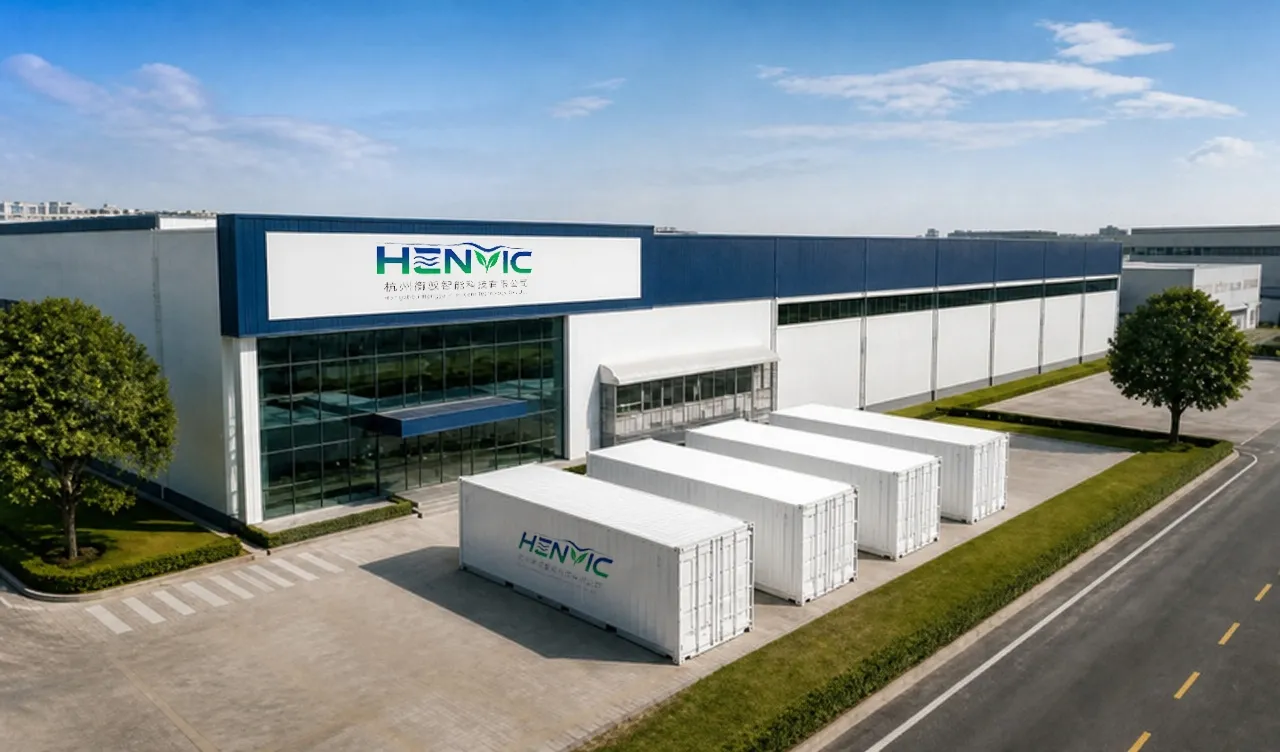
Everything begins with the enclosure. A standard 40-foot high-cube container — roughly 12 meters long, 2.4 meters wide, 2.9 meters high — is insulated, sealed against pests and airborne contaminants, and penetrated with electrical, plumbing, and refrigerant lines. Inside, multi-tier racks multiply growing area within a fixed footprint.
This layer answers a specific question: how does the root zone receive water, oxygen, and nutrients? The three common answers represent different trade-offs.
Deep water culture floats roots in an oxygenated solution — simple, forgiving, cheap, but slow to respond to concentration changes because of reservoir volume, and vulnerable to pathogen spread through shared water.
Nutrient film technique trickles a thin solution film through inclined channels. Roots get both water and air, and the shallow film allows rapid observation and adjustment. The vulnerability is the film itself: with no reservoir buffer, a pump failure or channel blockage can dry an entire tier within hours.
Aeroponics suspends roots in air and mists them on an interval. Water and nutrient efficiency reach their practical maximum, and oxygen is unlimited. The cost is complexity — nozzles clog, mist cycles need tuning, and tolerance for interruption is the lowest of the three.
Two physical realities at this layer shape everything above it. First, nearly all electrical energy delivered to the LEDs becomes heat, and the plants add transpiration on top. Lighting design and climate control load are therefore a single thermodynamic problem, not two separate systems. Second, vertical density creates non-uniform microclimates: warm humid air rises, so upper tiers run warmer and drier than lower ones; dense canopies trap their own boundary layer of saturated air, stalling transpiration; CO₂ injected at one point does not distribute evenly across five levels of leaf mass. The physical layer does not merely provide a place to grow — it generates the specific measurement and control problems the next two layers exist to solve.
Layer Two: The Perception Layer — Giving the Box Senses
Perception converts assumptions into state. Sensor arrays continuously report temperature, humidity, CO₂ concentration, PPFD at canopy level, nutrient solution pH and electrical conductivity, dissolved oxygen, water level, and flow rates.
Two of these deserve particular emphasis because they are not optional instrumentation. pH and EC jointly determine nutrient availability: a perfectly balanced nutrient recipe is useless if either drifts, because EC measures total concentration but not the ratio of ions, and plants do not absorb all ions at equal rates. Over a growth cycle, a recirculating solution can drift out of balance while the headline conductivity number still looks correct. Managing this is chemistry over time, not tank-filling.
The perception layer is also where vision enters. Canopy imaging with computer vision estimates leaf area, detects discoloration, flags early disease or pest pressure, and in some systems counts flowers or fruit. This is a qualitative shift: sensors report the environment, cameras report the crop. A farm that can measure its plants is doing something a thermostat-driven greenhouse cannot.
Perception quality has a hard ceiling set by physical reality. Sensors drift and require calibration. An EC probe fouling with biofilm reports plausible but wrong values. A CO₂ sensor near an exhaust vent reads local conditions rather than room conditions. The perception layer's job is not to be perfect but to be trustworthy and self-aware — to know when its own readings are suspect. Everything downstream inherits this trustworthiness, or its absence.
Layer Three: The Control Layer — Turning Measurement Into Judgment
Control sits above perception and converts state into action. Actuators include HVAC, dehumidifiers, LED dimming and spectrum shifting, CO₂ injection, nutrient dosing pumps, and circulation fans.
The progression within this layer is worth tracing, because it explains where the word "smart" earns its place.
At the reactive level, a controller maintains setpoints using feedback — a thermostat writ large. Temperature drifts above target, cooling engages. pH drifts low, base is dosed. This is automation, and it is genuinely useful, but it is also blind: it corrects deviations only after they occur.
At the predictive level, model predictive control and machine learning anticipate rather than react. The controller knows that a planned increase in light intensity will add heat and transpiration load, so it pre-adjusts cooling and dehumidification instead of chasing the consequences. A container is unusually well suited to this: it is a closed system with known dynamics and measured inputs, far more tractable than a greenhouse, where the environment beyond the glass is uncontrollable and constantly changing.
At the adaptive level, the setpoints themselves become outputs rather than constants. The system does not hold 22°C because someone decided 22°C was right. It holds whatever temperature optimizes growth given current light intensity, humidity, CO₂ level, crop stage, and projected harvest date — and it revises that decision every few minutes. The target migrates from a fixed number to a computed value.
This is the layer that also enables capabilities with no conventional analogue. Dynamic spectrum control shifts light quality across the growth cycle to steer morphology, flavor, or metabolite content — blue for compact growth and stomatal behavior, far-red for extension responses, specific blue and UV fractions to stimulate anthocyanins and aroma compounds. CO₂ enrichment synchronized with stomatal opening maximizes uptake efficiency. Deficit irrigation timed to the hour manipulates crop quality rather than merely sustaining it. These are not refinements of traditional practice; they exist only when every variable is measured and every actuator is programmable.
The operator's role shifts accordingly — from doing to supervising. One person can oversee multiple containers, review anomalies, adjust strategy, and decide harvest timing remotely.
Where the Loop Closes: Learning Across Cycles
The three layers form a loop rather than a stack, and the loop's memory is what separates a smart farm from an automated one. Every growth cycle generates data: light recipes, climate trajectories, nutrient drift, imaging histories, yields, quality metrics. That data feeds back into the models. Over successive harvests, the system converges on recipes tuned to a specific cultivar, a specific container, and a specific market's quality expectations.
This produces a property that conventional agriculture cannot replicate. A container farm that has run for two years is not the same machine it was on day one, and because every unit is physically identical, a recipe validated in one container transfers directly to the others. Learning scales with the physical footprint — which is emphatically not true of fields, where every plot has its own soil, slope, and microclimate.
The Honest Constraints
The architecture is elegant, but it does not repeal physics or economics.
Energy remains the binding constraint. Lighting, cooling, and dehumidification dominate operating cost. Intelligence can optimize energy use; it cannot make the light free. The model's carbon footprint is essentially a function of the local grid mix.
Crop range stays narrow. Leafy greens, herbs, microgreens, and some berries fit. Staple grains do not, and are not close to doing so — vertical stacking multiplies floor productivity, not energy efficiency, so the more tiers you add, the more light you must buy. Claims that container farms can feed cities are overstatements.
Complexity is a real operating cost. Sensors drift, models misjudge, chillers fail, software has bugs. A smart farm must be maintained as a system, and much of the sector's attrition traces to operational complexity rather than horticultural difficulty. The required skill set — electrical, refrigeration, nutrient chemistry, data monitoring — is genuinely different from conventional farming.
Capital intensity resists scale. The upfront investment is substantial, and expanding means adding containers, which means multiplying HVAC and electrical infrastructure. Industrial processes usually improve economically with size; replicating discrete boxes does not automatically deliver that effect.
What the Three Layers Actually Produce
Strip away the terminology and the architecture describes one move: converting plant growth from an agricultural outcome into a control problem with measurable state. The physical layer builds a system worth measuring. The perception layer measures it. The control layer acts on it, and then learns from the result.
What the farm ultimately produces is not only lettuce. It is knowledge about how to grow that lettuce better next time — encoded, transferable, and cumulative. The steel box is the body. The sensors are the senses. The algorithms are the judgment. Whether that adds up to a solution, a niche, or something in between depends on the price of a kilowatt-hour and the market value of the crop. But the thinking itself is no longer the novelty. It is the baseline.