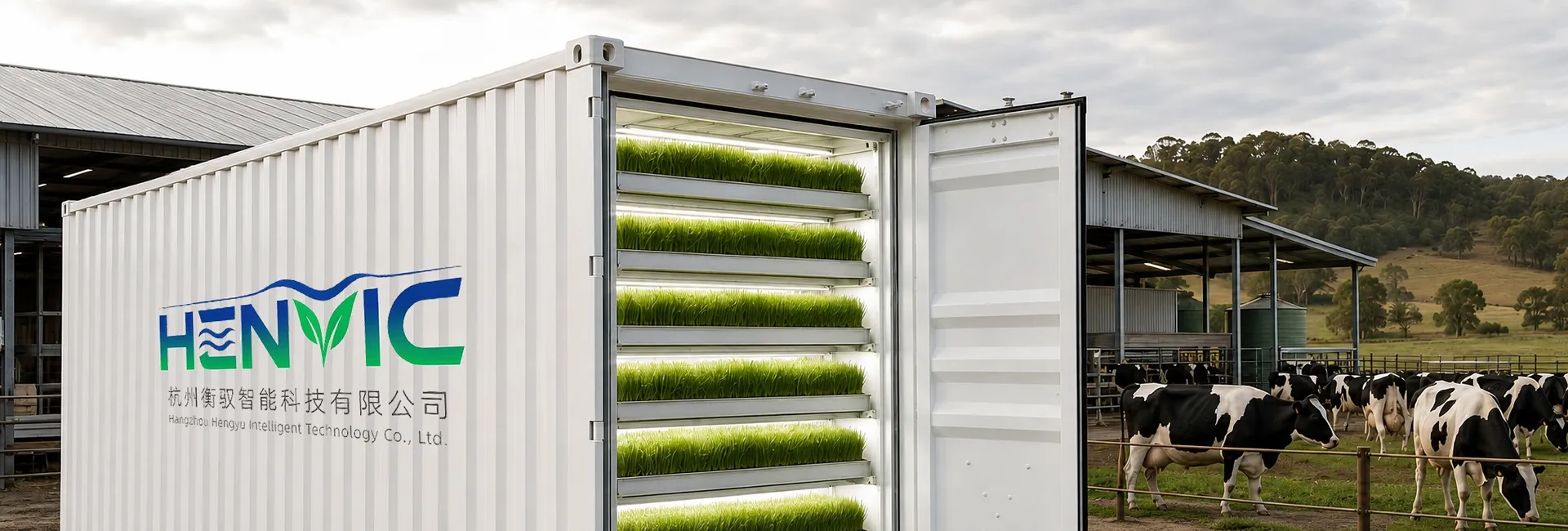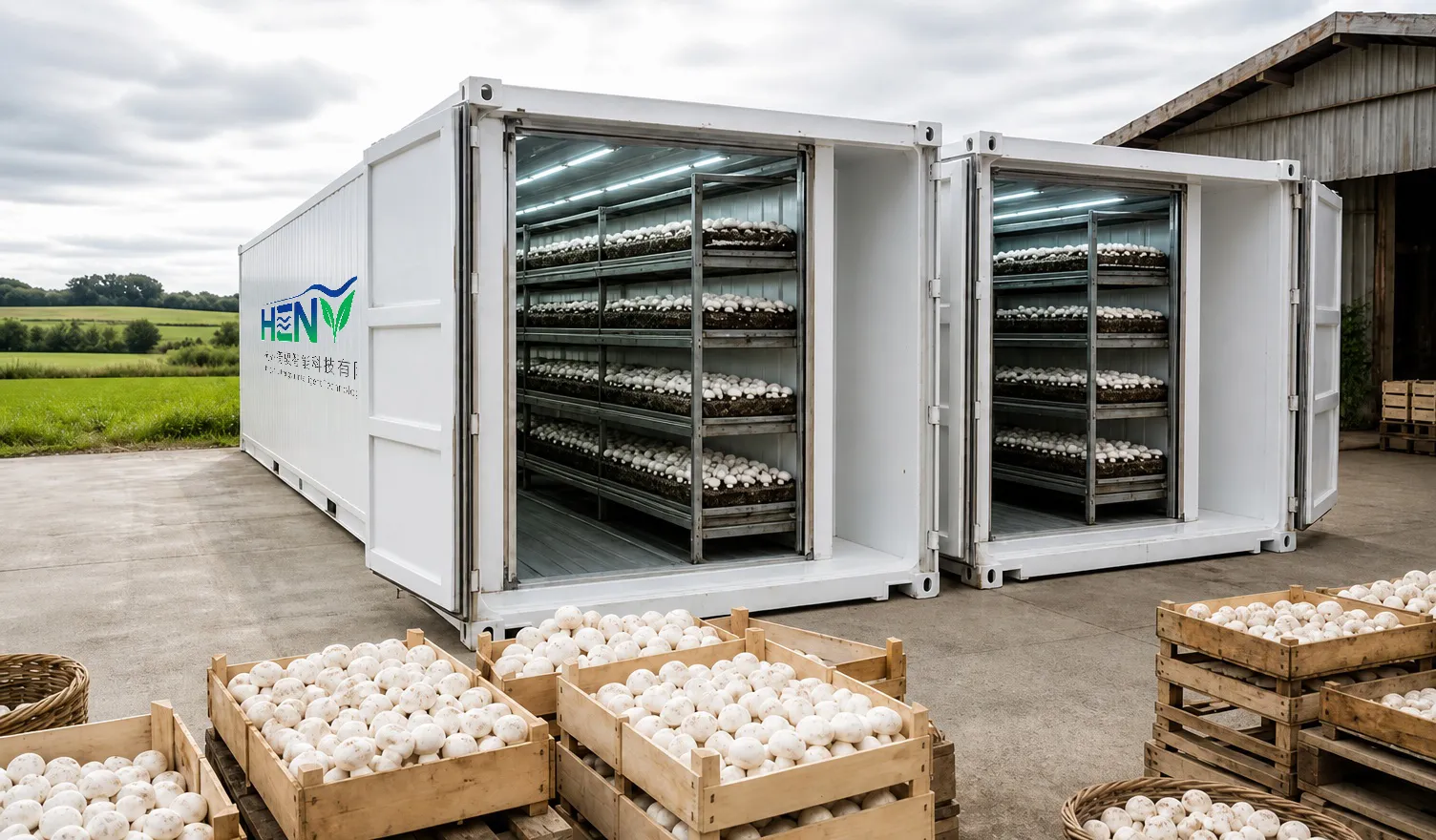
The decisive difference between a container farm and a greenhouse is that the container has no vent. There is no louvre to open when the box gets hot, no ridge vent to dump humidity, no natural draft to move air. Every gram of water vapour transpired by the crop must be condensed and removed mechanically, and every watt of heat generated inside the box must be rejected to the outside by refrigeration. Climate control in a container farm is not an accessory to cultivation; it is the binding constraint on what can be grown and at what cost.
The Two Loads
The climate system handles two distinct loads, and conflating them is a common design error.
The sensible load is heat. Its sources are the light-emitting diode fixtures, the circulation fans, the pumps and chillers, and conduction through the container's shell. In a well-insulated unit, lighting typically dominates. The sensible load is what determines the refrigeration capacity needed to hold air temperature at setpoint.
The latent load is water vapour. Transpiration rate scales with light intensity, temperature, humidity and canopy area; for a mature leafy crop, a rack of trays can transpire several litres per day, and the full container volume multiplies that across tiers. The latent load is what determines dehumidification capacity, and it is frequently underestimated at the design stage — particularly because transpiration peaks a few hours into the light period, roughly coinciding with peak sensible load.
The ratio of latent to sensible load is not fixed. It changes as the crop grows, as the photoperiod advances, and as setpoints change. A system sized for the seedling stage may be inadequate at canopy closure. This is why climate capacity should be specified against the peak-load condition — mature canopy, mid-photoperiod — with margin, rather than against an average.
Dehumidification: The Hard Part
Standard air conditioning removes moisture as a by-product of cooling the air below its dew point, and this is the mechanism container farms rely on. Cooling coils condense water out of the airstream and drain it away. The efficiency of this process depends on coil temperature and on the humidity of the return air: at high humidity, a great deal of latent energy can be removed per unit of cooling, but at lower humidity the coil must be driven colder, and sensible cooling dominates the energy budget.
This creates a characteristic tension. Keeping the box cool requires running the cooling system; keeping the box dry also requires running the cooling system, but for a different reason and often at a different coil temperature. Systems that are optimised for temperature setpoint may not deliver adequate dehumidification, and vice versa. Practical solutions include dedicated dehumidifiers alongside the primary cooling system, deeper and slower air-cooled coils designed to run wet, and control logic that prioritises whichever variable is further from setpoint.
Passive desiccant wheels, common in commercial building systems, are generally avoided in container farms because they exchange air with the outside — an unacceptable biosecurity risk. Solid-desiccant systems that regenerate internally exist but add complexity and heat load.
Air Distribution and the Canopy Boundary Layer
Temperature and humidity measured at a sensor are not what the leaves experience. Each leaf sits within a thin boundary layer of still, saturated air through which vapour must diffuse before it reaches the bulk airstream. Without sufficient air movement, that layer thickens, transpiration stalls, and the leaf surface warms — conditions that favour tip burn, calcium deficiency and disease.
Air circulation fans are therefore not optional. The design goal is a gentle, uniform airflow through the canopy, typically targeted at something like 0.3 to 0.7 metres per second at leaf level, enough to refresh the boundary layer without causing wind damage or excessive transpiration. Placement matters: air must reach the centre of the rack, not simply blow along the aisle. And because the airflow pattern changes as the canopy fills in, plants that grow into a dead zone will show it.
Vapour Pressure Deficit as the Unifying Variable
Experienced operators control to vapour pressure deficit rather than to temperature and relative humidity separately. Vapour pressure deficit expresses the drying power of the air — the difference between the saturation vapour pressure at leaf temperature and the actual vapour pressure of the surrounding air. It unifies the effects of temperature and humidity into a single number that predicts transpiration and therefore nutrient and water uptake.
This matters because relative humidity alone is misleading. Thirty per cent humidity at 15 degrees is a very different condition from thirty per cent at 30 degrees. Controlling to vapour pressure deficit keeps the crop's water relations inside a physiological band regardless of how temperature and humidity individually vary to get there. Container farm controllers increasingly take vapour pressure deficit as a primary setpoint and modulate cooling, dehumidification and fan speed to hold it.
Heat Rejection and Site Conditions
Whatever heat the climate system captures must be rejected somewhere. Air-cooled condensing units, mounted outside the container, require clearance and airflow; in a hot climate, packed against a wall or in a sun-exposed yard, their capacity degrades precisely when it is most needed. Water-cooled systems can be more compact and efficient but need a cooling tower or a water source. In cold climates, low ambient conditions offer free cooling potential, but the refrigerants and controls must be specified to handle low-ambient operation without losing the ability to dehumidify.
The building or site around the container is part of the thermal system. Shading the container shell, providing a ventilated canopy over the condensing units, and avoiding radiant surfaces that bake the box all reduce load without any change inside.
Control Strategy and Failure Modes
Modern container controllers coordinate cooling, dehumidification, carbon dioxide dosing, circulation and lighting dimming in a single loop. Coordination matters because these systems compete: running lights generates heat and transpiration; ramping cooling dehumidifies but also chills the root zone if the reservoir sits in the airstream; adding carbon dioxide requires the box to remain sealed, which precludes any form of ventilation-based temperature relief.
The failure modes to design around are predictable. A blocked condensate drain floods the floor and raises humidity. A frozen coil shuts down dehumidification while hidden behind a temperature setpoint that appears satisfied. A failed circulation fan creates a stagnant pocket that shows up as a disease focus weeks later. Redundancy, alarms and condensate drainage sized well beyond the anticipated volume are the practical defences.
Climate control is where a container farm's engineering budget concentrates, because the box removes every natural escape route. Success is not a matter of buying a larger air conditioner. It is a matter of understanding the load, controlling to the variable the plant actually experiences, and building the system so that its failure modes are visible.